
Pentimento.
an alternative to reinventing yourself


Imagine you’re sitting with me. A fly on the wall. There’s a client, and his press release would tell you he is very capable.
He’s his wife’s “rock”, the guy who “shows up”. However, you and I are looking at a human who is not healthy.
What gets him praise in public is punishing him in private. (but wait, it gets even better) He knows all this. Nothing we’re looking at (the crap sleep, the subpar exercise, the growing temper with his family) is anything like a revelation to him.
He knows ALL of that, yet...change feels impossible for him.
Why? I’m convinced “reinventing ourselves” feels terrifying and a terrible idea because it implies that we have to demolish everything that we’ve built and that has made us successful (at least publicly). Changing our identity is akin to knocking out a load-bearing wall during a remodel: there’s a pretty good chance the marriage, the company, the sense of competence, and the daily decision architecture will all come down with it.
And so most of us don’t touch it.
We don’t touch it because our identity DID get us where we are. The wall IS load-bearing, and we’ve watched plenty of people reinvent themselves and lose the marriage or the George Costanza haircut along the way. It’s become a cliché.
So we renovate elsewhere. Don’t touch the load-bearing wall, but let’s hire the executive coach. Let’s join YPO. Let’s see if these knuckles can get any whiter while I’m death gripping my “always present” persona.
If this is you, if you’ve been reading the same self-help message for the last 20 years, I have an alternative. It’s older than self-help and quieter than renovation.
X-ray a late Rembrandt or Caravaggio, and you’ll find an earlier composition underneath. A hand that used to be raised. A face that used to be turned away. These masters didn’t throw the mistake away; they painted over it.
The art world calls this pentimento. The earlier figure is still there, just demoted from the foreground to the substrate. It’s still doing work (it organizes the rest of the structure), but it isn’t showing itself anymore.
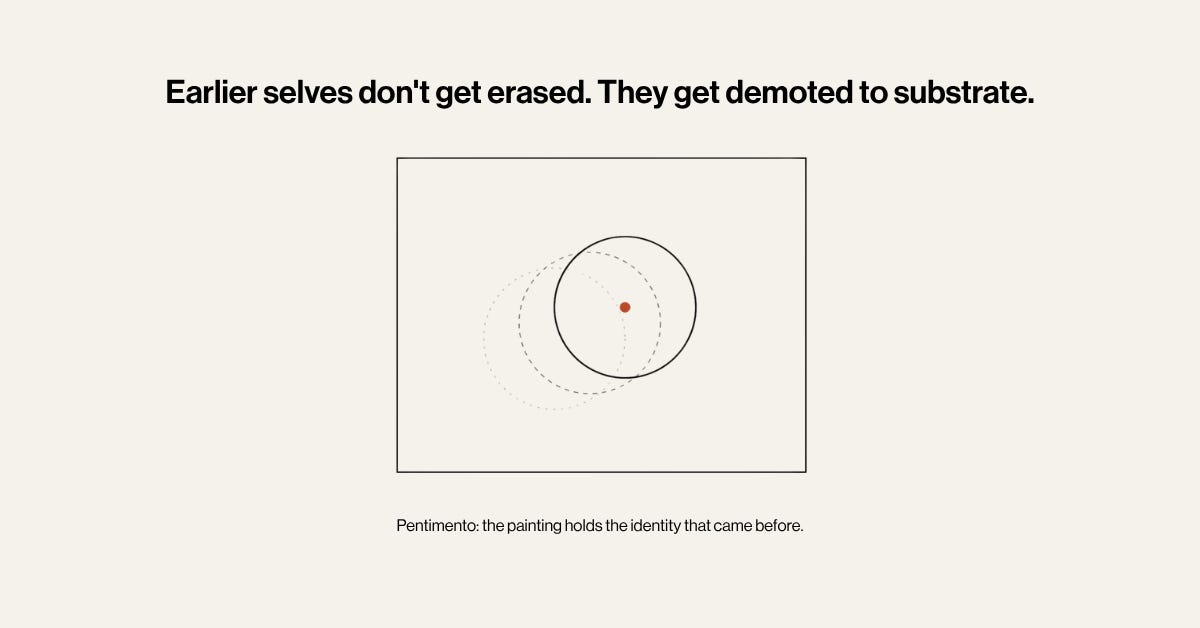
Versions of our identity that have served us well don’t need to be thrown out or demolished; they just need to be demoted to the background.
Moving from one layer to the next has a structure to it.
Identity moves through stages, and Nietzsche gives us three images for it.
We all start as camels. We kneel and ask to be loaded with the heaviest things: duty, expectation, inherited rules. The whole “thou shalt” is laid across our backs.
Next is the lion. The lion’s job is to demote what isn’t working by roaring NO at the thou-shalts (the dragon).
Last is the child (isn’t that great?). We’re no longer fighting and rebelling; we’re playing. Painting new figures over the old ones.
Maturity is returning to a simpler version of yourself. It’s not naive, it’s earned. The mature brain isn’t the one with the most connections. It’s the brain that has cut most of them.
Identity maturation is reductive, not additive.
I’d like to take a break from our very highbrow conversation (my words, not yours) and say that it would be much easier to coach fitness and health at the level of behavior. Sleep more, eat this, lift that. We’re not trained to dismantle identity or take down a load-bearing wall!
But THIS is why people can change in the short term, and they keep coming back to exactly who they were before. That’s not a metaphor. I’ve high-fived some of the same people multiple times over 20 years who got in shape and then are right back in the same chair, telling me the same story in a slightly different costume.
As you’ve been reading this, let’s create a sentence stem together, shall we?
I have been running on the assumption that ___. That assumption has been protecting me from ___. I am choosing to stop treating it as a fixed rule.
Fill it in. For real. Type it on your phone, scratch it on a note card. One more. This one’s a Q+A
Who in your private life would notice first if you pentimento’d yourself, and what would they notice?
With those two sentences in hand, come back to the wall. Those sentences didn’t knock the wall down; they just painted over it.
V/R, Spencer
“I have been running on the assumption that I can always do more. That assumption has been protecting me from feeling like I am not enough. I am choosing to stop treating it as a fixed rule” - Sounds like I need to pray more. Or maybe less is more. Oh the hamster wheel goes on….