
Coachland
The third option for burnt out coaches

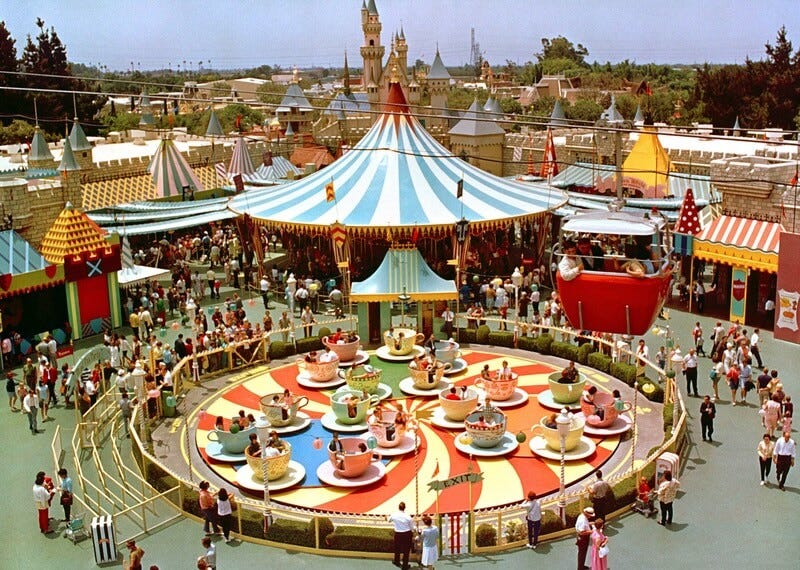
You have two adult avatars in the world, I believe. The types that hate Disneyland and want you to know it, and the ones who, low-key, dig it.
I am the latter.
Tom Sawyer Island, the Swiss Family Robinson treehouse, the Main Street Dixieland jazz band. Maybe one of the most creative immersions you can experience as a kid, and I find myself wanting to recreate that nostalgia for my own kids.
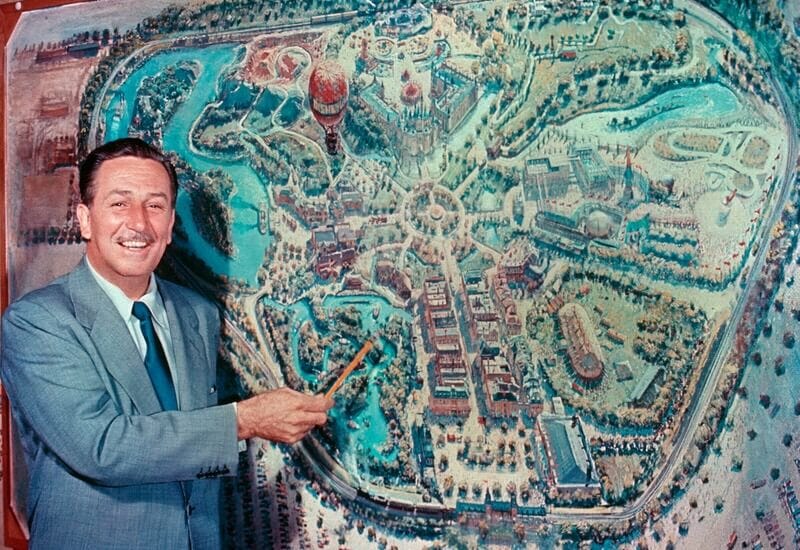
I share all this because I recently came across a great video of how Disneyland was made. What I had no appreciation for was that Walt broadcast the entire process, from a pile of dirt to the grand opening, on public television. Pretty amazing, given that it wasn’t a sure thing it would succeed.
Inside the walls of the health and fitness business I own, Behavior & Performance Research, it is all about the client. Outside of Washington Avenue, we’re taking those concepts we’ve learned and we want to bring you along for the ride of building an educational certification and affiliation for coaches. If BPR is the real production studio, this thing we’re talking about is more like, uh, Coachland [we’ll get with creative on the naming aspect].
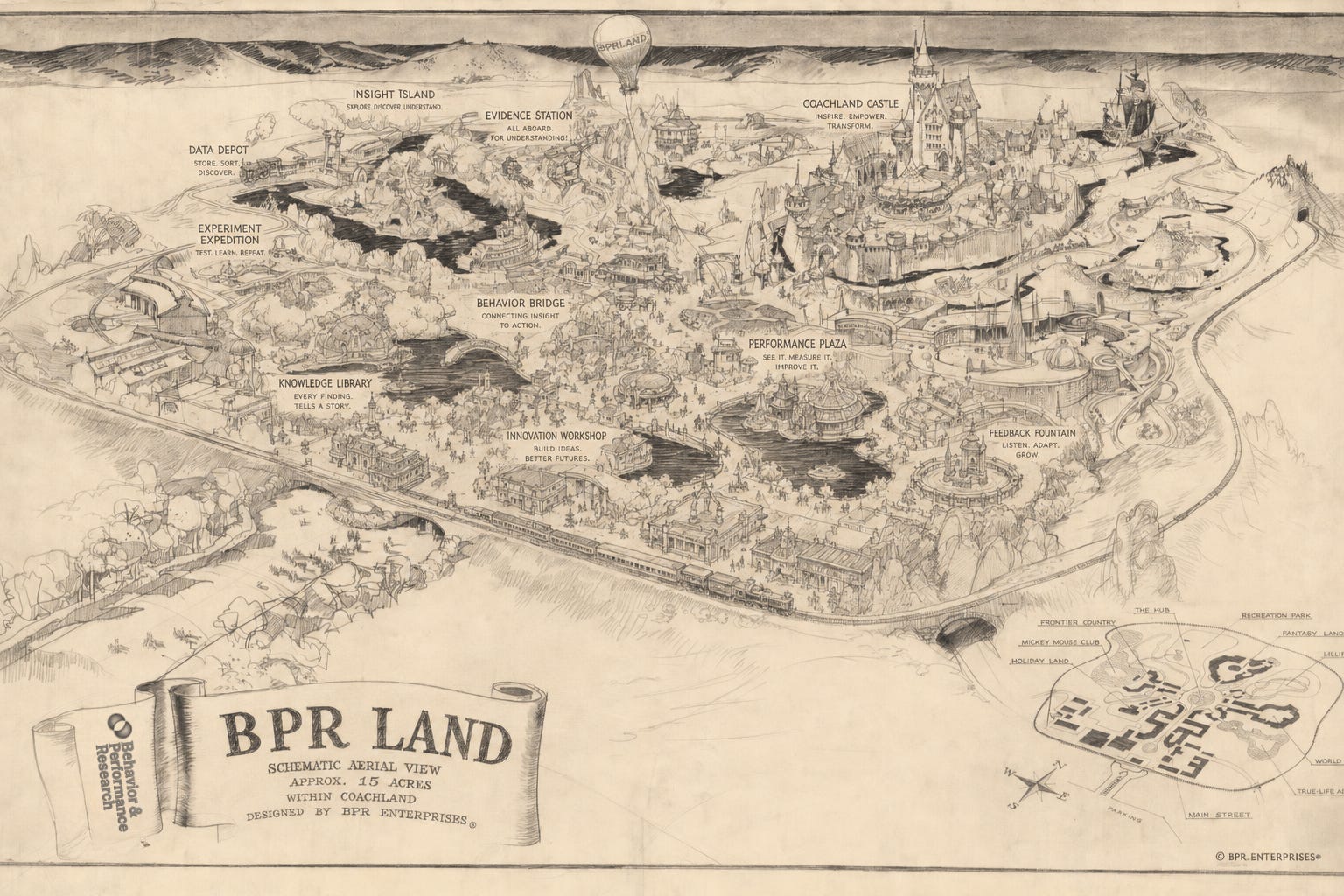
We’re a little further along than a pile of dirt, but on this Substack, I’ll occasionally be speaking about some aspect of what we’re creating in public. Just like good ol’ Walt. No churros here. My hope is that if you’ve found a kindred spirit in the essays so far, you’ll find these of note as well.
What it means to be a coach
Most coaches in health and fitness plateau at the same place I plateaued, getting more and more certain about the tools, more and more refined in our subject-matter expertise, and watching it not survive contact with real people.
I believe most people become a coach (and I’m talking specifically about health and fitness) based on really ambitious and noble intentions of helping people. They themselves have possibly been transformed and want to help transform others. So they look for a way to take a really big and abstract word like “helping” and make sense of how they might go about it. They look for things they can feel confident in communicating.
I’m convinced that’s why so many of us gravitate towards fitness and health. Because we were presented some very specific tools, some very specific skills that appeared like, if we could just get competent at those (program design, basic biomechanics, sound nutritional advice, etc.), we’d have what it takes to really make a difference.
And I’m not saying those tools don’t make a positive impact in people’s lives. They do. But along the way, gaining more and more certainty about these skills, it’s very easy to optimize them.
The tools aren’t the villain here. I mean, thank God for tools, but it’s a fundamentally flawed belief system to think that all that’s required of us is to find the right tool. So tools aren’t the problem, but if all you do is reach for more and more, you become a tool (oh don’t HURT EM, SPENCER!).
For a long time I was that guy. I made sweeping generalizations about how, if this one particular way was good for me and a few others, wouldn’t these tools be good for most? If it doesn’t work for you, “here…let me show you how to use this tool better”.
Going about coaching like this isn’t ethically wrong; it just doesn’t age very well. It doesn’t survive contact with real life.
And so, I believe coaching under the umbrella of health and fitness is one of the most disenchanting professions you can be in. Everyone either comes to this realization that the tools they have worked so hard to develop don’t always work and they become jaded and eventually leave the industry, or they live in blissful ignorance or denial that they are not really doing much besides introducing a few key concepts to people and providing an environment to practice them.
Let’s say you have devoted your last ten years to energy system training. You have deeply studied the Gerschler-Reindel Model. You know of Pat O’Shea. You’ve studied under modern-day savants like James FitzGerald and Joel Jamieson. You have personalized this information in the form of a bespoke program you wrote for a client.
And they don’t do it.
It’s very easy to say “well, this person doesn’t get it” or “well, this person wasn’t ready.”
It’s much harder to say you don’t have the right strategy.
The third option
There’s a third option, besides changing industries or just pursuing more and more subject-matter expertise. It’s the much harder game of zooming out to a place of confidence in problem-solving and coaching in general.
That’s right. Problem-solving and understanding the large framework of “how things work” sound basic but, as I’ve heard Krista Scott-Dixon first coin, they are the metaskills of coaching.
Basic isn’t the same as simple. So What, the eternally cool first track on Kind of Blue, is really just two chords. On paper, I can press my fingers on the two five-note voicings Bill Evans first wrote down.
I cannot, however, play jazz based on that very basic template.
If we wanted to stay in fitness AND we wanted to accept a few realities of life:
One size does not fit most.
There are several ways we can get better, and they all relate to health, and therefore to fitness and performance.
Life is constantly changing and is very easy to make more complex.
We can be a subject-matter expert of a few areas of fitness, but we cannot, by virtue of not being with someone every waking hour, be an expert of their life.
…we’d want a way to zoom in and zoom out. And a different relationship with the client than most of us have really thought about.
The proposed methodology I’m building in public, for the coach who wants to go deep (and not get lost there), is the following:
Relationship. Lifestyle Assessment. Insight. Minimum Effective Dose.
Relationship
The callback to the beginning is that I believe coaches want to reduce the suffering of those they interact with. They just haven’t been given a very good model. The model we’ve received is either “look as good as you can so people will listen to you” or “be as smart as you can so people will think you know more.” Or some combination of the two.
Why that line of thinking is so dysfunctional is that no amount of authority gets anyone to change long-term. Inspiration and aspiration are wonderful, but I’m convinced hierarchical relationships serve a short-term purpose. Egalitarian, friendly, and collaborative are much more fruitful, especially when you don’t know where the two of you might end up in terms of what you need to focus on.
The relationship with the client is one of a fellow human, who just happens to have thought about this stuff more than they have. That’s not the same as an expert. It’s more like a guide.
Lifestyle assessment
I say lifestyle because it’s very common (and for good reason) to have a physical assessment within the context of health and fitness coaching. What’s less common is to zoom out and look at a much larger data collection of patterns across several different areas of one’s life. We have goals, but unless we can see where all the inputs and constraints of those goals live, we might be prone to enthusiastically put effort into any area that really isn’t a bottleneck, or isn’t the biggest bottleneck to begin with.
This is borrowed from Eliyahu Goldratt. His Theory of Constraints argues that a system’s output is governed by its single tightest constraint, and that working anywhere else is wasted motion. Most coaches try to solve a focus problem with more exercise. Goldratt would call that running the wrong machine faster.
To make sense of all of this, we need a way to make sense of it. This is where frameworks and mental models of how systems work, and how constraints impact output, have made a tremendous difference in understanding (not perfectly, but more closely to reality) what’s going on.
(One little caveat before moving on. A few months ago, I thought that going to this level of depth would torpedo scale, or in other words, the number of people you can help. I no longer think that. There are some exciting tools we’re developing in the pilot programs that allow us to understand people at 20x the rate we would with pen and paper.)
Insight
You establish a much different relationship with a client than you might have in your previous life. That support, that encouragement, can’t be overstated. You have a map, a model of how you want to zoom out and look at someone’s health in its totality, and now you’ve got to zoom not just back where you started, but to a microscopic level of where the constraint is.
Without a dogmatic approach for the client, you’re agnostic about where you should focus. You’re no longer trying to solve a focus issue with more exercise. You’re no longer trying to solve sleep with better nutrition. These things are all in the same loop of influence, but for insight, we address the thing that is holding us up. This is a discovery, together, with the client leading and you shining the flashlight on just the next steps ahead.
Minimum effective dose
The most effective process for removing any constraint from a system, such as your health and fitness, is contrary to what’s popular. Maximum non-lethal dose is more like it. But, I believe, that’s usually where we already have some capacity. We’ve already scaffolded some skills that we’re applying intensity to.
To address a constraint, the high areas of friction in our life, the opposite is true. White-knuckling only lasts so long, and only works so well.
The minimum effective dose is the maximum sustainable dose. It’s where you start, not where you finish. Most coaches have the tools to zoom back in and apply progression, and know how to regress back to basics. What’s fun is that this can be applied across any area.
Exposure and conditioning are words that exist in both physical and psychological health. They’re the same. Go through the simplest version that a client can acquire the skill of, and rehearse it enough that they can do it without it “being a big deal.”
All of this sounds abstract. That’s because it’s a strategy, not another set of tactics. A read, not a set of plays. The triangle offense was famously hard to teach because it wasn’t a set of plays at all. It was a read. Same thing here. It IS figureoutable, but the figuring out is the work.
Coachland is past the dirt. Nowhere near the churros. See you on the job site.
V/R,
Spencer
The “third option” for burned-out coaches is the conversation the industry avoids. Most coaches are told to either grind harder inside the service model or escape into some fake passive-income funnel. But the real leverage is usually operational: better systems, clearer promises, cleaner client selection, and a business that stops depending on the coach’s nervous system being permanently overclocked.